
Label Printing CTP Machine
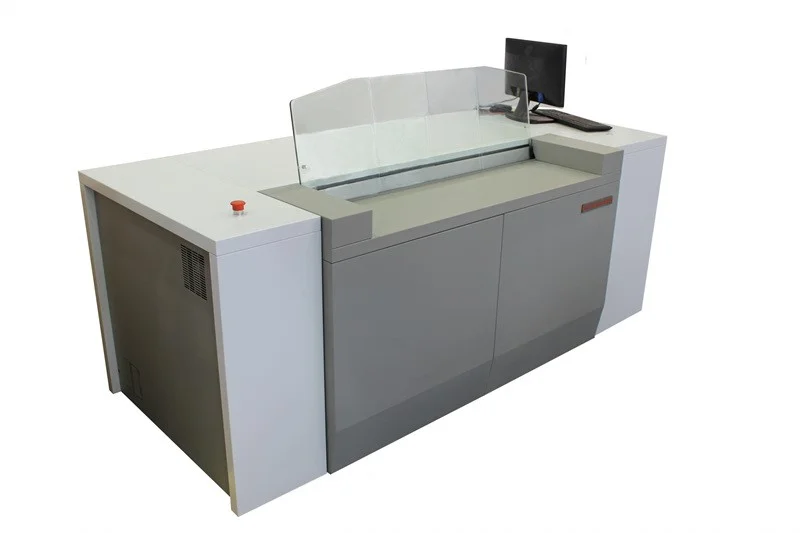
1. Proven laser diode technology with automated imaging facility
McLantis CTP ensures very clear and sharp dot and high run length. Day light operation. Failure of any channel of laser diode will not stop the CTP. The CTP can use the remaining channels to work. Therefore, McLantis CTP ensures continuous production and maintenance convenience.
2. Dynamic autofocus
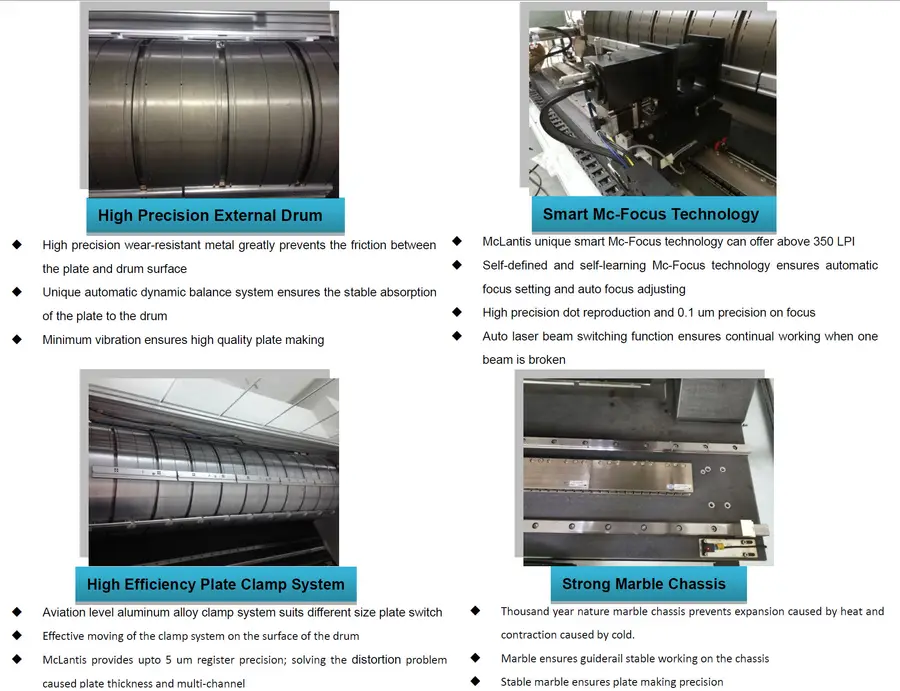
McLantis CTP utilizes the fifth generation dynamic auto focusing technology. The precise distance measuring system can detect the subtle change in distance of 0.1 microns. Driven by the voice coil motor, McLantis CTP make sures each spot is exposed in the best focal length exposure to ensure the consistent, clear and sharp dot.
3. Unique dot control and distortion prevention technology
McLantis unique graphical calibration technology can perfectly reproduce rectangle, eliminating dimensional deviation caused by different plate thickness. McLantis CTP can make precise compensation for dot gain problem caused by the laser spot size. McLantis CTP can perfect perform 1% to 99% step. One single McLantis CTP plate registration accuracy is 5 microns. It can reach 15 microns after calibrating with two different McLantis CTP’s.
4. High precision ceramic surface external drum
McLantis CTP high precision external metal drum efficiently prevents the friction between the plate and the drum. McLantis CTP utilizes DDS technology to ensure the phase jittering frequency within 1/32 pixel, to ensure straight and smooth vertical and horizontal line.
5. Automatic dynamic balance system
McLantis drum system balance block can automatically adjust to the new location up to only 5 seconds to adjust, to switch instantaneously for various sizes of plates.
6. High efficiency plate clamp
McLantis CTP utilizes the printing press type clamp and eliminate mishandling of different size plates.
7. Automatic energy balance
The temperature control system inside the laser constant shielding box can automatically precise temperature to plus or minus 0.1 degrees. And at a precise temperature condition, light intensity can be automatically calibrated every 8 hours to ensure the consistence of the laser energy.
8. New generation Mag-lev linear motor
McLantis CTP is incorporated with the world's top brand liner motor, eliminating the machining error of silk screw.
9. Natural marble working platform
McLantis CTP utilizes 1000 year natural marble as working platform to ensure high precision and prevents expansion caused by heat and contraction caused by cold.
10. Gigabit ethernet data transmission and 1 bit tiff interface
McLantis CTP machine is dedicated to any CTP workflow with perfect seamless connectivity by high speed and precision gigabit ethernet card.
| Model | MACSETTER LB |
|---|---|
| Light Channels | 32 beams |
| Output Speed(Plate/hour) | 25 p/h |
| Light Source | 830 nm Laser Diode |
| Repeatability | ± 5 microns |
| Interface | 1000 base-T |
| Output Resolution | 2540 dpi |
| Dot Reproduction | 1%-99% |
| Register Accuracy | within 0.01mm |
| Plate Size | Max.670x640mmMin.250x250mm |
| Suitable Plates | thermal CTP plate |
| Plate Thickness | 0.15-0.40mm |
| Plate Loading and Unloading | Loading: Semi-automation(Standard Set)Unloading: AutomationVacuum Fixation |
| Plate Balance | Automatic Balance |
| Environment | Temperature 25℃±3℃Humidity 40-70%(Non-condensing) |
| Machine Dimension | 1500 x 1300 x 1150 mm(W* |
| Net Weight | 800kg |
| Power Supply | 5.5 KW/220V±5%, 50/60Hz |
Frequently Asked Questions
What are the key specifications of Label Printing CTP Machine?
Light Channels: 32 beams; Output Speed(Plate/hour): 25 p/h; Light Source: 830 nm Laser Diode; Repeatability: ± 5 microns; Interface: 1000 base-T; Output Resolution: 2540 dpi; Dot Reproduction: 1%-99%; Register Accuracy: within 0.01mm; Plate Size: Max.670x640mmMin.250x250mm; Suitable Plates: thermal CTP plate; Plate Thickness: 0.15-0.40mm; Plate Balance: Automatic Balance
About McLantis & Ordering FAQ
About McLantis Technology
What is laser direct imaging (LDI) and how does it work?
LDI (Laser Direct Imaging) uses a focused laser — driven by our proprietary Laser MEMS and DLP digital optics — to expose circuit patterns directly onto photoresist-coated boards, replacing traditional film and contact exposure. It delivers micron-level registration, higher yields and faster job setup for PCB and advanced packaging production.
What is computer-to-screen (CTS)?
CTS (Computer-to-Screen) writes the screen image directly onto the emulsion-coated mesh with a digital optical head, eliminating film, capillary film and manual exposure. It is the standard prepress step for textile, ceramic, glass and industrial screen printing.
Which industries do McLantis systems serve?
Our direct-imaging and prepress equipment is used across PCB fabrication, screen printing, textile and ceramic decoration, glass and packaging, and precision micro-fabrication — from prototyping shops to high-volume factories worldwide.
Products & Customization
What product lines does McLantis offer?
We offer LDI laser direct imaging systems, CTS computer-to-screen systems, CTP platesetters, digital inkjet printing lines, and custom DLP / Laser-MEMS micro-fabrication lines built on shared precision motion-control and optical platforms.
Can McLantis equipment be customized for my process?
Yes. Beyond standard models, we design custom exposure and imaging lines — different fields of view, resolutions, substrates and throughput — around our modular Laser MEMS and DLP engine. Share your substrate size, resolution and capacity targets and our engineers will propose a configuration.
What substrates and software are supported?
Systems handle standard PCB substrates, screen meshes, plates and roll or sheet media. Imaging is driven by open file workflows (Gerber, PDF, TIFF) and is compatible with mainstream RIP and prepress software; our team assists with integration during installation.
Ordering, Pricing & Lead Time
How do I request a quote?
Use the inquiry form on our Contact page or email info@mclantisgroup.com with your application, substrate, resolution and target throughput. Our sales engineers reply within 48 hours with a configuration and quotation.
What is the typical lead time and minimum order quantity?
Standard models typically ship in 4–8 weeks; customized lines are quoted case by case. The minimum order quantity is one unit, and we support single-machine pilot deployments before line-scale rollout.
What warranty and after-sales coverage is included?
Every system ships with a standard 12-month warranty covering the optical engine, motion system and controls, with global technical support, remote diagnostics and on-site service options through our regional bases.
Support, Installation & Service
Do you provide installation and operator training?
Yes. Each system is delivered with on-site or remote installation, calibration and hands-on operator training so your team can run production confidently from day one.
How are spare parts and long-term service handled?
We stock critical spares at our regional manufacturing bases and ship globally. Preventive-maintenance plans, firmware updates and lifetime technical support keep your line running throughout its service life.
Do you support export, shipping and local compliance?
We export worldwide with experience across Asia, Europe, the Americas, the Middle East and Africa. Equipment is built to meet common electrical and safety standards, and we handle documentation, crating and freight to your port.