
Metalltintenkan-Druck CTP-Maschine
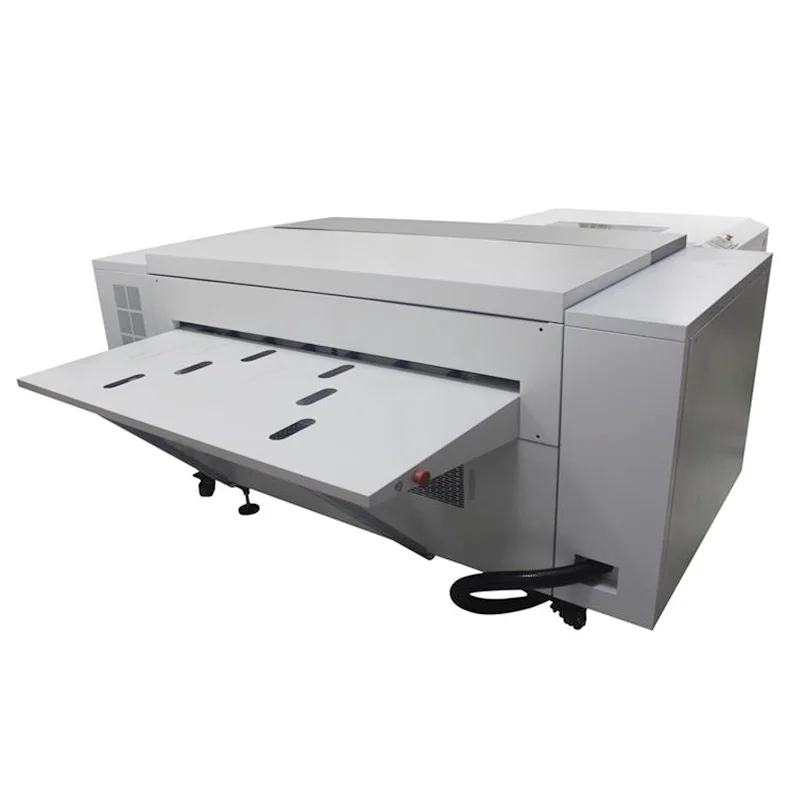
Eignet sich für alle wichtigen Metalltintenkan-Druckplattengrößen. Spezielles Design, um spezielle Plattenklemmen zu passen.
1. Erprobte Laserdiode-Technologie mit automatisierter Bildgebungsfunktion
McLantis CTP gewährleistet sehr klare und scharfe Punkte sowie hohe Lauflängen. Taglichtbetrieb. Bei Ausfall eines Laserdiodenkanals wird die CTP nicht gestoppt. Die CTP kann die verbleibenden Kanäle weiterhin nutzen. Daher gewährleistet McLantis CTP eine kontinuierliche Produktion und Wartungskomfort.
2. Dynamisches automatisches Fokussieren
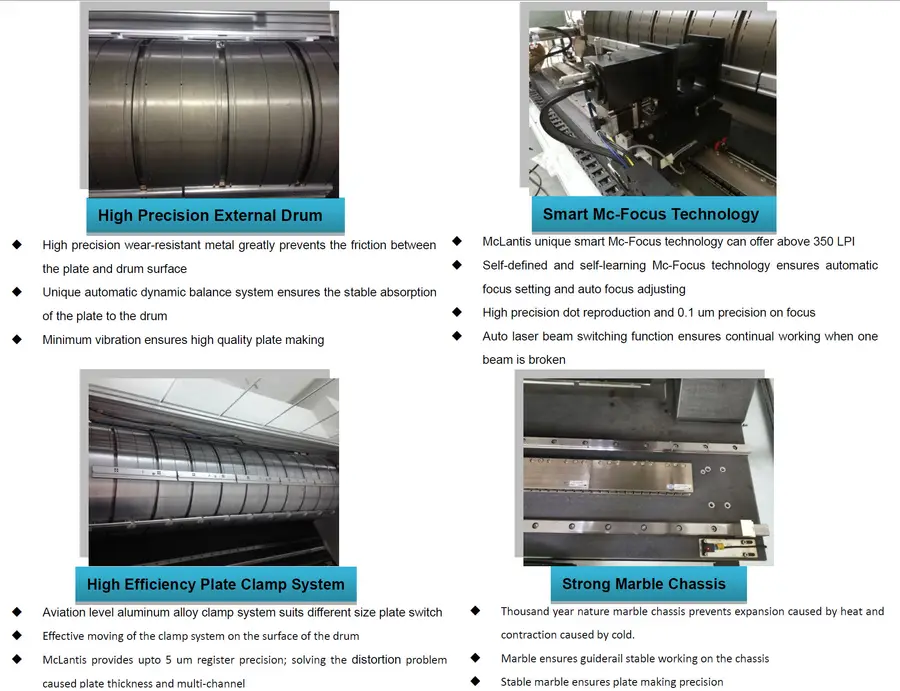
McLantis CTP nutzt die fünfte Generation dynamischer automatischer Fokussierungstechnologie. Das präzise Distanzmesssystem kann Veränderungen von 0,1 Mikrometern erkennen. Angetrieben von einem Sprachspulmotor sorgt McLantis CTP dafür, dass jeder Punkt in der besten Fokalstrecke exponiert wird, um konsistente, klare und scharfe Punkte zu gewährleisten.
3. Einzigartige Punktsteuerung und Verzerrungsvermeidungstechnologie
McLantis einzigartige grafische Kalibrierungstechnologie kann Rechtecke perfekt wiedergeben und vermeidet Maßabweichungen, die durch unterschiedliche Plattenstärke verursacht werden. McLantis CTP kann präzise Kompensation für das Problem der Punktverstärkung durch die Laserpunktmgröße durchführen. McLantis CTP kann 1 % bis 99 % Schritte perfekt durchführen. Die Plattenregistrierungsgenauigkeit einer einzigen McLantis CTP beträgt 5 Mikrometer. Nach Kalibrierung mit zwei verschiedenen McLantis CTPs kann sie 15 Mikrometer erreichen.
4. Hochpräzises keramisches Oberflächenaußenrad
McLantis CTPs hochpräzises externes Metallrad verhindert effizient die Reibung zwischen der Platte und dem Rad. McLantis CTP nutzt DDS-Technologie, um die Phasenstörungsfrequenz innerhalb von 1/32 Pixel zu gewährleisten, um gerade und glatte vertikale und horizontale Linien zu gewährleisten.
5. Automatisiertes dynamisches Ausgleichssystem
McLantis Radsystem Ausgleichsblock kann sich automatisch auf die neue Position einstellen, bis zu 5 Sekunden, um den Wechsel zu verschiedenen Plattengrößen sofort zu ermöglichen.
6. Hochleistungsfähige Plattenklemme
McLantis CTP nutzt die Druckmaschinenart Klemme und vermeidet die falsche Handhabung von Platten unterschiedlicher Größe.
7. Automatisierter Energieausgleich
Das Temperaturregelsystem innerhalb der Laserkonstanten Schutzkammer kann die Temperatur präzise auf ± 0,1 Grad automatisch einstellen. Bei präziser Temperaturbedingung kann die Lichtintensität alle 8 Stunden automatisch kalibriert werden, um die Konsistenz der Laserenergie zu gewährleisten.
8. Neue Generation Mag-lev Linearmotor
McLantis CTP ist mit dem weltweit führenden Linearmotor ausgestattet, der die Fertigungsfehler von Seilschrauben eliminiert.
9. Naturmarmor Arbeitsplatte
McLantis CTP nutzt 1000 Jahre alten Naturmarmor als Arbeitsplatte, um eine hohe Präzision zu gewährleisten und Ausdehnung durch Hitze und Kontraktion durch Kälte zu vermeiden.
10. Gigabit Ethernet Datenübertragung und 1 Bit TIFF-Schnittstelle
McLantis CTP-Maschine ist für jeden CTP Workflow geeignet und gewährleistet eine perfekte nahtlose Verbindung durch schnelle und präzise Gigabit Ethernet-Karte.
| Modell | MACSETTER MT |
|---|---|
| Max. Plattengröße | 1200x1400mm |
| Min. Plattengröße | 508x394mm |
| Auflösung | 2400DPI, 2540DPI |
| Wiederholbarkeit | ± 8µm |
| Bildtyp | External drum, 32 beams thermal sensitive CTP |
| Plattentyp | 830nm thermal sensitive CTP plate |
| Plattendicke | 0.15-0.4mm |
| Beladen | Single plate, manual loading |
| Fähigkeit | 10 sheets/hour |
| Abmessungen | 2880x1310x1310mm |
| Gewicht | 2600kg |
| Arbeitsumgebung | Temperature:20-25 degree C Humidity:40-60% |
Frequently Asked Questions
Was sind die wichtigsten Spezifikationen von Metalltintenkan-Druck CTP-Maschine?
Max. Plattengröße: 1200x1400mm; Min. Plattengröße: 508x394mm; Auflösung: 2400DPI, 2540DPI; Wiederholbarkeit: ± 8µm; Bildtyp: External drum, 32 beams thermal sensitive CTP; Plattentyp: 830nm thermal sensitive CTP plate; Plattendicke: 0.15-0.4mm; Beladen: Single plate, manual loading; Fähigkeit: 10 sheets/hour; Abmessungen: 2880x1310x1310mm; Gewicht: 2600kg
About McLantis & Ordering FAQ
About McLantis Technology
What is laser direct imaging (LDI) and how does it work?
LDI (Laser Direct Imaging) uses a focused laser — driven by our proprietary Laser MEMS and DLP digital optics — to expose circuit patterns directly onto photoresist-coated boards, replacing traditional film and contact exposure. It delivers micron-level registration, higher yields and faster job setup for PCB and advanced packaging production.
What is computer-to-screen (CTS)?
CTS (Computer-to-Screen) writes the screen image directly onto the emulsion-coated mesh with a digital optical head, eliminating film, capillary film and manual exposure. It is the standard prepress step for textile, ceramic, glass and industrial screen printing.
Which industries do McLantis systems serve?
Our direct-imaging and prepress equipment is used across PCB fabrication, screen printing, textile and ceramic decoration, glass and packaging, and precision micro-fabrication — from prototyping shops to high-volume factories worldwide.
Products & Customization
What product lines does McLantis offer?
We offer LDI laser direct imaging systems, CTS computer-to-screen systems, CTP platesetters, digital inkjet printing lines, and custom DLP / Laser-MEMS micro-fabrication lines built on shared precision motion-control and optical platforms.
Can McLantis equipment be customized for my process?
Yes. Beyond standard models, we design custom exposure and imaging lines — different fields of view, resolutions, substrates and throughput — around our modular Laser MEMS and DLP engine. Share your substrate size, resolution and capacity targets and our engineers will propose a configuration.
What substrates and software are supported?
Systems handle standard PCB substrates, screen meshes, plates and roll or sheet media. Imaging is driven by open file workflows (Gerber, PDF, TIFF) and is compatible with mainstream RIP and prepress software; our team assists with integration during installation.
Ordering, Pricing & Lead Time
How do I request a quote?
Use the inquiry form on our Contact page or email info@mclantisgroup.com with your application, substrate, resolution and target throughput. Our sales engineers reply within 48 hours with a configuration and quotation.
What is the typical lead time and minimum order quantity?
Standard models typically ship in 4–8 weeks; customized lines are quoted case by case. The minimum order quantity is one unit, and we support single-machine pilot deployments before line-scale rollout.
What warranty and after-sales coverage is included?
Every system ships with a standard 12-month warranty covering the optical engine, motion system and controls, with global technical support, remote diagnostics and on-site service options through our regional bases.
Support, Installation & Service
Do you provide installation and operator training?
Yes. Each system is delivered with on-site or remote installation, calibration and hands-on operator training so your team can run production confidently from day one.
How are spare parts and long-term service handled?
We stock critical spares at our regional manufacturing bases and ship globally. Preventive-maintenance plans, firmware updates and lifetime technical support keep your line running throughout its service life.
Do you support export, shipping and local compliance?
We export worldwide with experience across Asia, Europe, the Americas, the Middle East and Africa. Equipment is built to meet common electrical and safety standards, and we handle documentation, crating and freight to your port.