
Digitaler Tintenstrahldruckmaschine für Zeitungen
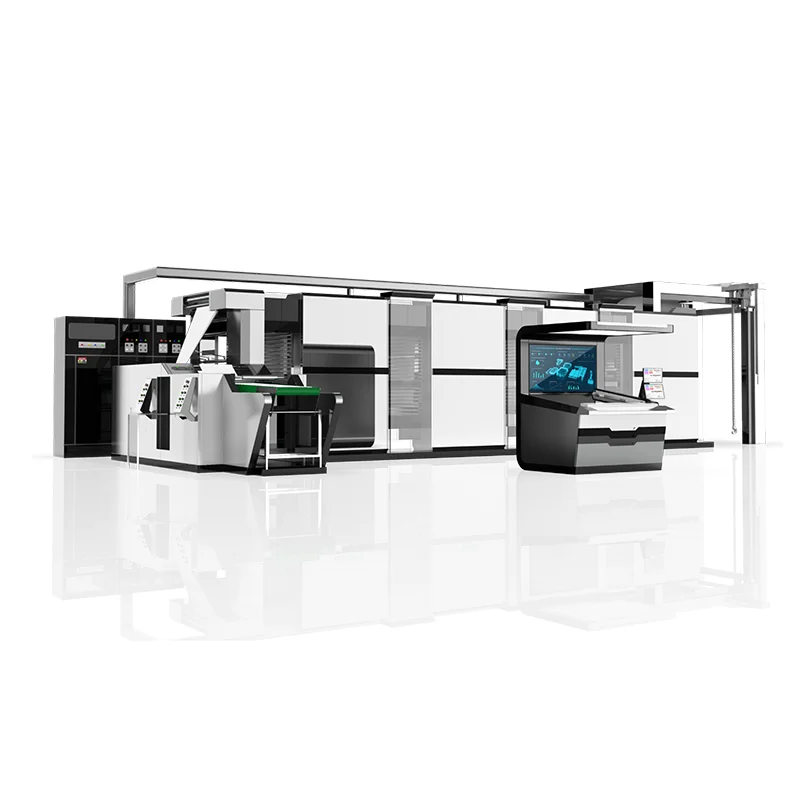
Das McLantis DIGIMAC-NEWS66 Inkjet-Zeitungsdrucksystem ist ein hochgeschwindigkeitsfähiges, digitales System, das für die automatisierte Produktion von Zeitungen und Kurzauflagen von Büchern konzipiert ist. Dieses System kombiniert digitales Inkjet-Drucken mit traditioneller Nachdruckfaltetechnologie, um eine effiziente, „one-sheet-start“-Produktionsablauf zu erreichen.
Systemaufbau und Workflow
Das System besteht aus drei Hauptmodularunit, die in einer kontinuierlichen Linie arbeiten:
· Auswickelvorrichtung: Unterstützt Papierrollen mit einem Durchmesser bis zu 1100 mm.
· Inkjet-Druckeinheit: Verfügt über eine 4+4-Doppelseitige vierfarbige Konfiguration für hochwertiges gleichzeitiges Drucken auf beiden Seiten des Papiers.
· Faltmodul (660-Faltwerk): Ein spezialisiertes Nachdruckmodul, das Zylinder-Schneiden (750 mm), Blattlagerung (1–6 Blätter) und ein Einfalten zur Herstellung fertiger Zeitungen durchführt.
Technische Spezifikationen
· Papierbreite: 597 mm.
· Druckgeschwindigkeit: Bis zu 150 Meter pro Minute (für ein Einzelblatt-Zeitung).
· Anwendbare Papierarten: Newsprint, woodfree Papier, Inkjet-coated Papier und Reispapier.
· Papiergewicht: Unterstützt leichte Materialien im Bereich von 35g bis 80g.
· Zusammenklappmaße: Die Standardfaltmaße betragen 597 mm x 375 mm.
Kerntechnologien
1. High-Präzisions-Tintenstrahlsystem: Das System verwendet die neuesten hochgeschwindigkeitsfähigen piezoelektrischen industriellen Spritzdüsen, die variable Punktbedruckung und eine adressierbare Auflösung bis zu 1200 x 1200 DPI unterstützen. Das Circulatingink-System hilft, Luftblasen zu eliminieren und verhindert Verstopfung der Düsen, wodurch eine konsistente Druckqualität gewährleistet wird.
2. Vollständige Servo-Kontrolle: Statt traditioneller Motoren und Getriebeketten ermöglicht das vollständige Servo-Kontrollsystem schnelle Reaktionen auf Störungen wie Papierstau oder Doppelschichten, was die Stabilität der Anlage erheblich erhöht.
3. Erweiterte Softwarearchitektur:
· Hochgeschwindigkeits-RIP: Gemeinsam mit der Peking-Universität entwickelt, kann das 64-Bit parallele RIP-System bis zu 1200 Seiten pro Minute verarbeiten und ermöglicht nahtlose Übergänge zwischen verschiedenen Druckaufträgen.
· Farbmanagement: Ein unabhängiges CMM-System und ICC-Generierungstechnologie ermöglichen automatische Farbabstimmung und dynamische Tintenkompensation.
· Variable Daten: Unterstützt den Echtzeit-Druck von variablen Texten, Barcodes und Bildern, was für personalisierte oder sichere Druckanwendungen unerlässlich ist.
Operative Vorteile
Das DIGIMAC-NEWS66-System ist besonders für die Stabilität bei hohen Geschwindigkeiten optimiert. Im Gegensatz zu einigen leichten Geräten, die bei Geschwindigkeiten über 80 m/min hohe Blockierquoten aufweisen, bleibt dieses Klappgerät stabil bei 120 m/min bis 150 m/min. Es verfügt über ein Touchscreen-Interface zur einfachen Anpassung der Anzahl der gespeicherten Blätter (1–6 Exemplare) und umfasst eine Verstopfungserkennung mit Notstopfunktion zur Schutz des Hardware und zur Reduzierung von Verschwendung. Diese Kombination aus digitaler Flexibilität und industriellen Stabilität macht es ideal für die moderne Zeitungserzeugung.


| Modell | DIGIMAC-NEWS66 |
|---|---|
| Papierbreite | 597 mm |
| Max. Papierrollendurchmesser | 1100 mm |
| Papiergewicht | 35g – 80g |
| Anwendbares Medium | Newsprint, Woodfree paper, Inkjet coated paper, and Rice paper |
| Maximale Druckgeschwindigkeit | 150 meters/minute (for a single-sheet newspaper) |
| Druckkopftechnologie | High-speed circulating on-demand piezoelectric industrial grade |
| Adressierbare Auflösung | 600 x 600 dpi, 600 x 1200 dpi, 1200 x 1200 dpi |
| Farbanordnung | 4+4 (double-sided four-color) |
| Schnittgröße | 597 mm (width) x 750 mm (cylinder cutting) |
| Falzspezifikation | Single fold: 597 mm x 375 mm |
| Bogenlagerkapazität | 1 to 6 sheets (adjustable via touchscreen) |
| Steuerungssystem | Full servo control system (replacing traditional motors/belts) |
| Sicherheitssystem | Paper jam detection and emergency stop |
| Software-Funktionen | Distributed high-speed RIP, color management (CMM), and variable data processing |
| Spannung und Leistung | 380V; Peak power 60 kW |
| Betriebsumgebung | Temp: 22.5–27.5°C; Humidity: 40%–70% |
Frequently Asked Questions
Was sind die wichtigsten Spezifikationen von Digitaler Tintenstrahldruckmaschine für Zeitungen?
Papierbreite: 597 mm; Max. Papierrollendurchmesser: 1100 mm; Papiergewicht: 35g – 80g; Anwendbares Medium: Newsprint, Woodfree paper, Inkjet coated paper, and Rice paper; Maximale Druckgeschwindigkeit: 150 meters/minute (for a single-sheet newspaper); Druckkopftechnologie: High-speed circulating on-demand piezoelectric industrial grade; Adressierbare Auflösung: 600 x 600 dpi, 600 x 1200 dpi, 1200 x 1200 dpi; Farbanordnung: 4+4 (double-sided four-color); Schnittgröße: 597 mm (width) x 750 mm (cylinder cutting); Bogenlagerkapazität: 1 to 6 sheets (adjustable via touchscreen); Steuerungssystem: Full servo control system (replacing traditional motors/belts); Sicherheitssystem: Paper jam detection and emergency stop
About McLantis & Ordering FAQ
About McLantis Technology
What is laser direct imaging (LDI) and how does it work?
LDI (Laser Direct Imaging) uses a focused laser — driven by our proprietary Laser MEMS and DLP digital optics — to expose circuit patterns directly onto photoresist-coated boards, replacing traditional film and contact exposure. It delivers micron-level registration, higher yields and faster job setup for PCB and advanced packaging production.
What is computer-to-screen (CTS)?
CTS (Computer-to-Screen) writes the screen image directly onto the emulsion-coated mesh with a digital optical head, eliminating film, capillary film and manual exposure. It is the standard prepress step for textile, ceramic, glass and industrial screen printing.
Which industries do McLantis systems serve?
Our direct-imaging and prepress equipment is used across PCB fabrication, screen printing, textile and ceramic decoration, glass and packaging, and precision micro-fabrication — from prototyping shops to high-volume factories worldwide.
Products & Customization
What product lines does McLantis offer?
We offer LDI laser direct imaging systems, CTS computer-to-screen systems, CTP platesetters, digital inkjet printing lines, and custom DLP / Laser-MEMS micro-fabrication lines built on shared precision motion-control and optical platforms.
Can McLantis equipment be customized for my process?
Yes. Beyond standard models, we design custom exposure and imaging lines — different fields of view, resolutions, substrates and throughput — around our modular Laser MEMS and DLP engine. Share your substrate size, resolution and capacity targets and our engineers will propose a configuration.
What substrates and software are supported?
Systems handle standard PCB substrates, screen meshes, plates and roll or sheet media. Imaging is driven by open file workflows (Gerber, PDF, TIFF) and is compatible with mainstream RIP and prepress software; our team assists with integration during installation.
Ordering, Pricing & Lead Time
How do I request a quote?
Use the inquiry form on our Contact page or email info@mclantisgroup.com with your application, substrate, resolution and target throughput. Our sales engineers reply within 48 hours with a configuration and quotation.
What is the typical lead time and minimum order quantity?
Standard models typically ship in 4–8 weeks; customized lines are quoted case by case. The minimum order quantity is one unit, and we support single-machine pilot deployments before line-scale rollout.
What warranty and after-sales coverage is included?
Every system ships with a standard 12-month warranty covering the optical engine, motion system and controls, with global technical support, remote diagnostics and on-site service options through our regional bases.
Support, Installation & Service
Do you provide installation and operator training?
Yes. Each system is delivered with on-site or remote installation, calibration and hands-on operator training so your team can run production confidently from day one.
How are spare parts and long-term service handled?
We stock critical spares at our regional manufacturing bases and ship globally. Preventive-maintenance plans, firmware updates and lifetime technical support keep your line running throughout its service life.
Do you support export, shipping and local compliance?
We export worldwide with experience across Asia, Europe, the Americas, the Middle East and Africa. Equipment is built to meet common electrical and safety standards, and we handle documentation, crating and freight to your port.