
CTP Raum Null Abfluss Lösungen
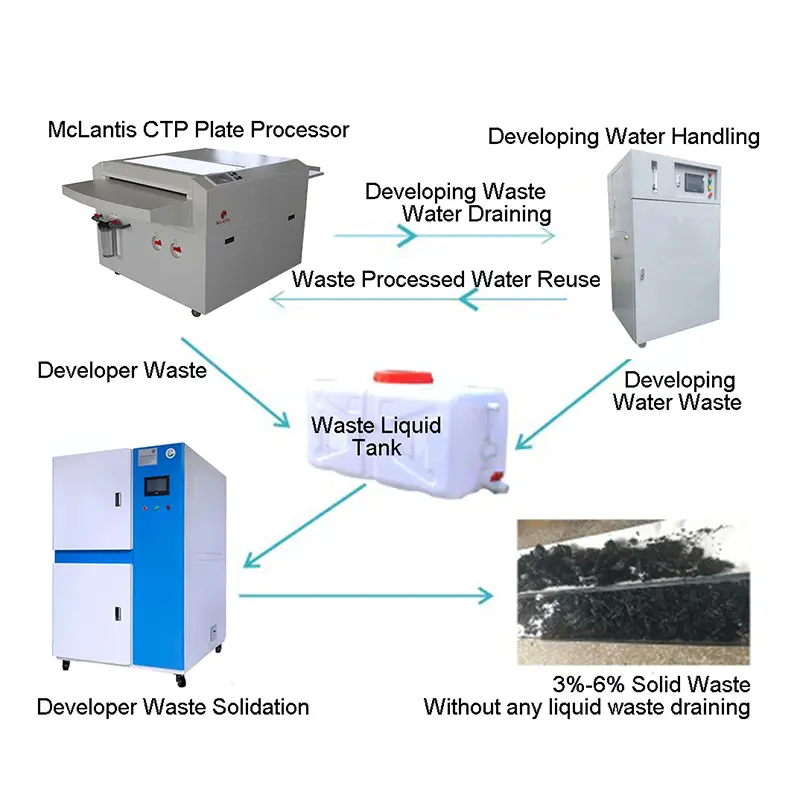
Lösung Teil A:
1. McLantis CTP Null Abfluss Lösungen verbindet eine Reihe hochleistungsfähiger Filterkreislaufsysteme parallel mit dem ursprünglichen Filterrohr des Plattenverarbeiters, was den ursprünglichen Kreislauffiltersystem nicht beeinträchtigt. Das System kann effektiv Verunreinigungen, Kristalle, Gel, etc. im Entwickler entfernen, während der Kreislauf des Entwicklers erhöht wird und Mikropartikel, Öl und Gummi im Entwickler entfernt werden.
2. Das Entwicklermedium wird in den Standardzustand gebracht, der Plattenverarbeitungseffekt wird stabilisiert, die Kristallbildung im Entwicklerbehälter wird deutlich reduziert und der Entwickler hat praktisch keine suspendierten Partikel. Es kann die Kristallbildung der Entwicklungsrollen und Bürsten deutlich reduzieren, physische Kratzer auf der Platte vermeiden, den Stillstandverlust von Papier, Tinte, Arbeitskraft etc. aufgrund von Plattenfehlern reduzieren, die Reinigungs- und Wartungszeit des Plattenverarbeiters verkürzen und die Produktivität erhöhen. Die Lebensdauer des Entwicklers wird mehr als verdoppelt. Es spart die Nutzungskosten des Entwicklers und der Abflussabwasser, verhindert den Blockieren der Rohrleitungen des Plattenverarbeiters, verbessert die Verarbeitungskapazität, reduziert die Umweltverschmutzung und Verarbeitungskosten durch Abwasserabfluss und verlängert die Lebensdauer des Plattenverarbeiters.
3. Nach der Filtration durch das Entwicklungsfilter-System wird die Qualität des Spülwassers deutlich verbessert und der Effekt der Plattenentwicklung wird verbessert.
Lösung Teil B:
4. Das Spülwasser der Platte wird automatisch durch chemische Mittel ergänzt, neutralisiert und flokuliert, und die Zusammensetzung des Entwicklers im Spülwasser wird analysiert, um die Wasserqualität wiederherzustellen, danach durch das Filter-System zur Aufnahme und Sedimentation von Verunreinigungen. Das Spülwasser wird auch durch Ozonbehandlung entfärbt und deodorisiert. Sterilisation ermöglicht die Wiederverwendung des Spülwassers. Etwa 1500 Platten werden unter den Bedingungen der Plattenentwicklung kontinuierlich entwickelt, und etwa 70 Liter zirkulierendes Wasser im Wasserbehälter werden in den Sammelbehälter und durch das Abwasserbehandlungssystem konzentriert. Laut der Menge von 10 Litern Wasser pro zu spülender Platte, 15 Tonnen Wasser für 1500 Platten ohne die Nutzung der McLantis CTP Null Abfluss Lösungen, und jetzt nur 70 Liter Wasser benötigt. Es spart mehr als 99% Wasser, reduziert die Abflussmenge der Druckabwasser deutlich, löst das Problem der Abwasserbehandlung durch Druckunternehmen und erreicht den Effekt von Energieeinsparung und Emissionenreduktion. Gleichzeitig kommt die McLantis CTP Null Abfluss Lösung mit einem Pufferwasserbehälter, um den Stillstandverlust durch Wasserschutz zu vermeiden und die Produktivität zu verbessern.
Lösung Teil C:
5. Das abgegebene Abwasser aus dem CTP Raum wird in den Pufferbehälter gesammelt. Die integrierte Pumpe des Geräts pumpt das Abwasser in das McLantis Entwicklerabwasserfeststoffsystem. Nach der Behandlung durch die niedertemperaturige Hybrid-Vakuumdestillation und Kondensation wird das Abwasser in feste Abfälle getrennt. Etwa 3-6% der verbleibenden festen Abfälle werden in den Schlammbehälter für die Entsorgung abgegeben. Die Nutzung dieses Geräts kann die Kosten der Abwasserrecycling von Unternehmen deutlich reduzieren.
Kundenvorbeispiele:
2 Sets von CTP Maschinen im Druck, täglich 1200 Platten herstellen.
Ohne McLantis CTP Null Abfluss Lösungen
Mit McLantis CTP Null Abfluss Lösung
10 Tage
Monatlicher Entwicklerabfluss
40L x 2 Maschinen x 10 Mal = 800L
40L x 2 Maschinen x 3 Mal = 240L
Jährlich Einsparung von 358,32 Tonnen Wasser, USD 3 pro Ton, jährlich Einsparung von USD 1074,96 Wasserkosten
| Ohne McLantis CTP Null-Abfluss-Lösungen |
|---|
| Mit McLantis CTP Null-Abfluss-Lösung |
| Zeitraum des Entwicklerwechsels |
|---|
| 3 days |
| 10 days |
| Monatliche Entwicklerentwässerung |
|---|
| 40L x 2 machines x 10 times = 800L |
| 40L x 2 machines x 3 times = 240L |
| Monatlicher Wasserverbrauch |
|---|
| 36000 x 10L = 360 tons |
| 36000 x 70L/1500 = 1.68 tons |
| Monatlicher Entwicklerüberlauf |
|---|
| 36000 x 0.1L = 3.6 tons |
| Monatliche Prozessorreinigung |
|---|
| 10 times |
| 3 times |
| Without McLantis CTP Zero Drainage Solutions:Developer waste 0.8 + 3.6 = 4.4 tons. Every ton USD 1000 disposal costs, every year totally USD 52800. |
|---|
| With McLantis CTP Zero Drainage SolutionDeveloper waste 0.048+0.72=0.768 tons. Every ton USD 1000 disposal costs, every year totally USD 9216. Saving disposal cost USD 43584 per year.Every year saving 358.32 tons water, USD 3 per ton, every year saving USD 1074.96 water cost |
|---|
Frequently Asked Questions
Was ist CTP Raum Null Abfluss Lösungen?
McLantis CTP Null Abfluss Lösungen verbindet eine Reihe hochleistungsfähiger Filterkreislaufsysteme parallel mit dem ursprünglichen Filterrohr des Platten…
About McLantis & Ordering FAQ
About McLantis Technology
What is laser direct imaging (LDI) and how does it work?
LDI (Laser Direct Imaging) uses a focused laser — driven by our proprietary Laser MEMS and DLP digital optics — to expose circuit patterns directly onto photoresist-coated boards, replacing traditional film and contact exposure. It delivers micron-level registration, higher yields and faster job setup for PCB and advanced packaging production.
What is computer-to-screen (CTS)?
CTS (Computer-to-Screen) writes the screen image directly onto the emulsion-coated mesh with a digital optical head, eliminating film, capillary film and manual exposure. It is the standard prepress step for textile, ceramic, glass and industrial screen printing.
Which industries do McLantis systems serve?
Our direct-imaging and prepress equipment is used across PCB fabrication, screen printing, textile and ceramic decoration, glass and packaging, and precision micro-fabrication — from prototyping shops to high-volume factories worldwide.
Products & Customization
What product lines does McLantis offer?
We offer LDI laser direct imaging systems, CTS computer-to-screen systems, CTP platesetters, digital inkjet printing lines, and custom DLP / Laser-MEMS micro-fabrication lines built on shared precision motion-control and optical platforms.
Can McLantis equipment be customized for my process?
Yes. Beyond standard models, we design custom exposure and imaging lines — different fields of view, resolutions, substrates and throughput — around our modular Laser MEMS and DLP engine. Share your substrate size, resolution and capacity targets and our engineers will propose a configuration.
What substrates and software are supported?
Systems handle standard PCB substrates, screen meshes, plates and roll or sheet media. Imaging is driven by open file workflows (Gerber, PDF, TIFF) and is compatible with mainstream RIP and prepress software; our team assists with integration during installation.
Ordering, Pricing & Lead Time
How do I request a quote?
Use the inquiry form on our Contact page or email info@mclantisgroup.com with your application, substrate, resolution and target throughput. Our sales engineers reply within 48 hours with a configuration and quotation.
What is the typical lead time and minimum order quantity?
Standard models typically ship in 4–8 weeks; customized lines are quoted case by case. The minimum order quantity is one unit, and we support single-machine pilot deployments before line-scale rollout.
What warranty and after-sales coverage is included?
Every system ships with a standard 12-month warranty covering the optical engine, motion system and controls, with global technical support, remote diagnostics and on-site service options through our regional bases.
Support, Installation & Service
Do you provide installation and operator training?
Yes. Each system is delivered with on-site or remote installation, calibration and hands-on operator training so your team can run production confidently from day one.
How are spare parts and long-term service handled?
We stock critical spares at our regional manufacturing bases and ship globally. Preventive-maintenance plans, firmware updates and lifetime technical support keep your line running throughout its service life.
Do you support export, shipping and local compliance?
We export worldwide with experience across Asia, Europe, the Americas, the Middle East and Africa. Equipment is built to meet common electrical and safety standards, and we handle documentation, crating and freight to your port.