
CTP Room Zero Drainage Solutions
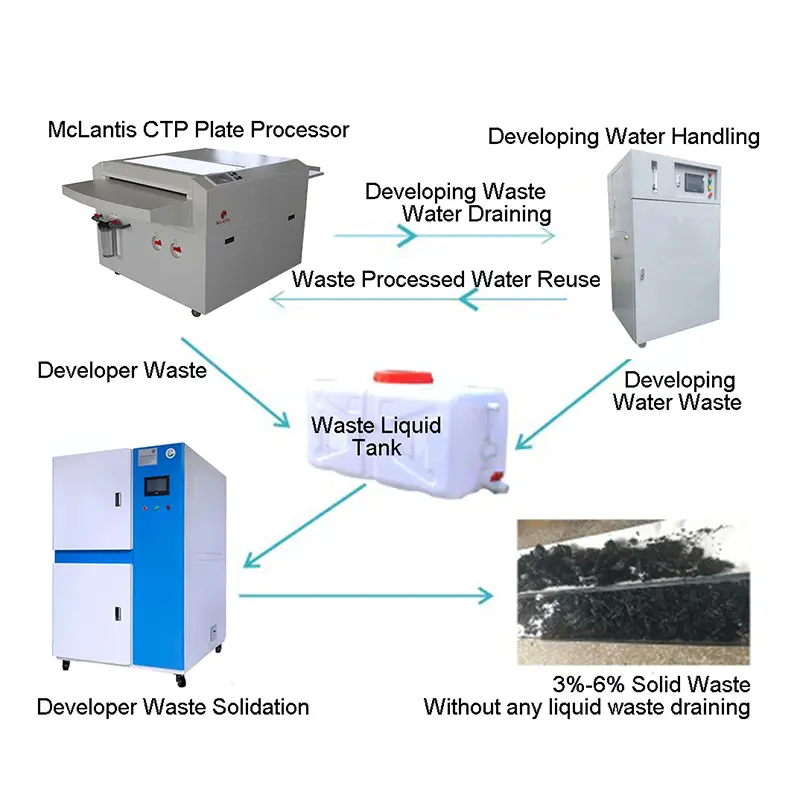
Solution Part A:
1. McLantis CTP Zero Drainage Solutions connects a set of high-power filtration circulation system in parallel with the original filtration pipeline of the plate processor, which does not affect the original circulation filtration system. The system can effectively remove impurities, crystals, gels, etc. in the developer, while increasing the circulation of the developer and removing micro-particles, oil, and gum in the developer.
2. Realize the standard state of the developer, stabilize the plate-making effect, greatly reduce the crystal precipitation in the developer tank, and the developer basically has no suspended matter. It can greatly reduce the crystallization of developing rubber rollers and brushes, avoid physical scratches on the plate surface, reduce the downtime loss of paper, ink, labor, etc. caused by plate failure, reduce the time of plate processor washing and maintenance, and improve the productivity. Extend the service life of the developer by more than twice. It saves the use cost of developer and waste liquid discharge, prevents the pipeline blockage of the plate processor, improves the processing capacity, reduces the pollution and processing cost caused by the discharge waste liquid, and prolongs the service life of the plate processor.
3. After being filtered by the developing filter system, the quality of the washing water is obviously improved and the effect of plate development is improved.
Solution Part B:
4. The plate washing water is automatically supplemented, neutralized and flocculated by chemical agents, and the developer composition in the plate washing water is analyzed to restore the water quality, and then pass the filtering system to intercept and precipitate impurities. The plate washing water is also decolorized and deodorized by ozone treatment. Sterilization realizes the recycling of the flushing water. Continuously develop about 1500 plates under the conditions of plate development, and about 70 liters of circulating water in the water tank are discharged into the collection box and concentrated by the waste liquid treatment system. According to the amount of 10L water for each plate to be washed, 15 tons of water for 1500 plates without using McLantis CTP zero drainage solutions, and now only 70 liters of water needs to be used. It saves more than 99% of water, greatly reduces the discharge of printing wastewater, solves the problem of wastewater treatment by printing enterprises, and achieves the effect of energy saving and emission reduction. At the same time, McLantis CTP zero drainage solutions comes with a buffer water tank to avoid downtime loss caused by water shutdown and improve production efficiency.
Solution Part C:
5. Collect the discharged waste liquid from the CTP room to the buffer barrel. The built-in pump of the machine pumps the waste liquid to the McLantis developer waste solidation system. The waste liquid is separated into solid waste after being treated by low-temperature hybrid vacuum distillation and condensation. About 3-6% of the remaining solid waste is discharged into the sludge storage tank for disposal. The use of this equipment can greatly reduce the cost of waste liquid recycling of enterprises.
Customer Examples:
2 sets of CTP machines in the press, everyday making 1200 plates.
| Without McLantis CTP Zero Drainage Solutions | With McLantis CTP Zero Drainage Solution | |
| Period of changing developer | 3 days | 10 days |
| Monthly Developer Drainage | 40L x 2 machines x 10 times = 800L | 40L x 2 machines x 3 times = 240L |
| Monthly Water Usage | 36000 x 10L = 360 tons | 36000 x 70L/1500 = 1.68 tons |
| Monthly Developer Overflow | 36000 x 0.1L = 3.6 tons | |
| Monthly Processor Washing | 10 times | 3 times |
| Without McLantis CTP Zero Drainage Solutions:Developer waste 0.8 + 3.6 = 4.4 tons. Every ton USD 1000 disposal costs, every year totally USD 52800. | ||
| With McLantis CTP Zero Drainage SolutionDeveloper waste 0.048+0.72=0.768 tons. Every ton USD 1000 disposal costs, every year totally USD 9216. Saving disposal cost USD 43584 per year.Every year saving 358.32 tons water, USD 3 per ton, every year saving USD 1074.96 water cost | ||
Frequently Asked Questions
Which models of CTP Room Zero Drainage Solutions are available?
Without McLantis CTP Zero Drainage Solutions / With McLantis CTP Zero Drainage Solution
What are the key specifications of CTP Room Zero Drainage Solutions?
Period of changing developer: 3 days; Monthly Developer Drainage: 40L x 2 machines x 10 times = 800L; Monthly Water Usage: 36000 x 10L = 360 tons; Monthly Developer Overflow: 36000 x 0.1L = 3.6 tons; Monthly Processor Washing: 10 times
About McLantis & Ordering FAQ
About McLantis Technology
What is laser direct imaging (LDI) and how does it work?
LDI (Laser Direct Imaging) uses a focused laser — driven by our proprietary Laser MEMS and DLP digital optics — to expose circuit patterns directly onto photoresist-coated boards, replacing traditional film and contact exposure. It delivers micron-level registration, higher yields and faster job setup for PCB and advanced packaging production.
What is computer-to-screen (CTS)?
CTS (Computer-to-Screen) writes the screen image directly onto the emulsion-coated mesh with a digital optical head, eliminating film, capillary film and manual exposure. It is the standard prepress step for textile, ceramic, glass and industrial screen printing.
Which industries do McLantis systems serve?
Our direct-imaging and prepress equipment is used across PCB fabrication, screen printing, textile and ceramic decoration, glass and packaging, and precision micro-fabrication — from prototyping shops to high-volume factories worldwide.
Products & Customization
What product lines does McLantis offer?
We offer LDI laser direct imaging systems, CTS computer-to-screen systems, CTP platesetters, digital inkjet printing lines, and custom DLP / Laser-MEMS micro-fabrication lines built on shared precision motion-control and optical platforms.
Can McLantis equipment be customized for my process?
Yes. Beyond standard models, we design custom exposure and imaging lines — different fields of view, resolutions, substrates and throughput — around our modular Laser MEMS and DLP engine. Share your substrate size, resolution and capacity targets and our engineers will propose a configuration.
What substrates and software are supported?
Systems handle standard PCB substrates, screen meshes, plates and roll or sheet media. Imaging is driven by open file workflows (Gerber, PDF, TIFF) and is compatible with mainstream RIP and prepress software; our team assists with integration during installation.
Ordering, Pricing & Lead Time
How do I request a quote?
Use the inquiry form on our Contact page or email info@mclantisgroup.com with your application, substrate, resolution and target throughput. Our sales engineers reply within 48 hours with a configuration and quotation.
What is the typical lead time and minimum order quantity?
Standard models typically ship in 4–8 weeks; customized lines are quoted case by case. The minimum order quantity is one unit, and we support single-machine pilot deployments before line-scale rollout.
What warranty and after-sales coverage is included?
Every system ships with a standard 12-month warranty covering the optical engine, motion system and controls, with global technical support, remote diagnostics and on-site service options through our regional bases.
Support, Installation & Service
Do you provide installation and operator training?
Yes. Each system is delivered with on-site or remote installation, calibration and hands-on operator training so your team can run production confidently from day one.
How are spare parts and long-term service handled?
We stock critical spares at our regional manufacturing bases and ship globally. Preventive-maintenance plans, firmware updates and lifetime technical support keep your line running throughout its service life.
Do you support export, shipping and local compliance?
We export worldwide with experience across Asia, Europe, the Americas, the Middle East and Africa. Equipment is built to meet common electrical and safety standards, and we handle documentation, crating and freight to your port.