
Kollimiertes Lichtbelichtungsgerät
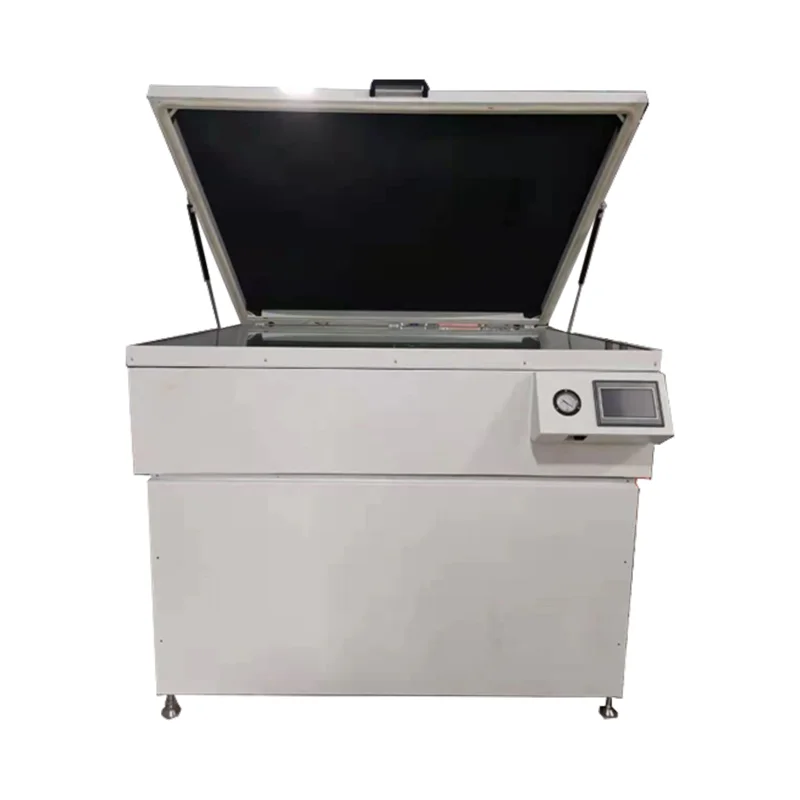
1. Starke Gerüststruktur
Der Lasttragende Teil des Gerätekörpers wird durch ein 50x50x3mm-Rahmen geschweißt. Die Rahmenstruktur und die hohetragfähige Struktur gewährleisten die langfristige Haltbarkeit des Geräts.
2. Hohe Präzision der Lichtquelle
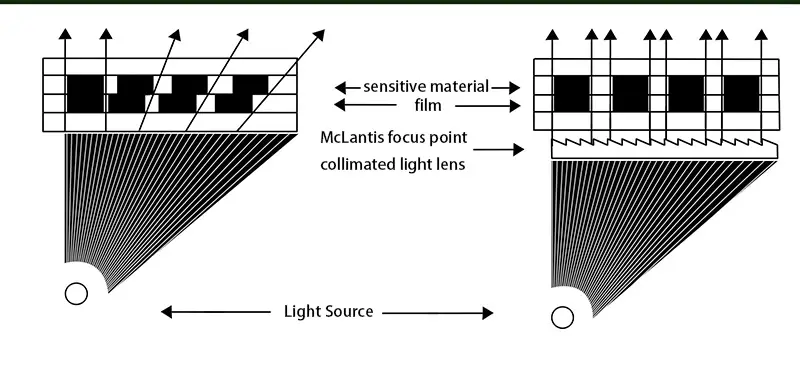
Durch die Verwendung einer speziell entworfenen parallelen Lichtquelle beträgt der Einfallshalbwinkel und der schräge Winkel des parallelen Lichts weniger als oder gleich 2 Grad, und die Lichtuniformität erreicht mehr als 95%.
3. Effiziente Kühlung, um Verformung des Designs zu vermeiden
Das Gerät ist mit einem Eis-Wasser-Kühlsystem und einer vernünftigen Luftkanalgestaltung ausgestattet, um Verformung des Designs zu vermeiden.
4. Effiziente Vakuumfunktion
Das橡胶皮肤wickelnde Design macht es leicht, die Werkstücke zu platzieren und zu entnehmen; der weiche Druckwalze kann die Luft zwischen dem橡胶 und dem Glas schnell ausdrücken, wodurch die Menge an Luft im Vakuumschacht reduziert und das Vakuumbildungsverfahren schnell abgeschlossen wird.
5. Energieeinsparung
Der hochverlässliche UV-Elektronik-Netzteil wird zur Versorgung der Lichtquelle verwendet, der Leistungsfaktor erreicht mehr als 96%, und die Leistungswandlungseffizienz ist hoch; die Lichtenergie kann schrittlos eingestellt werden, was die Lebensdauer der Lampe deutlich erhöht.
| Modell | EXPOMAC1215CSL | EXPOMAC1417CSL | EXPOMAC1722CSL |
|---|---|---|---|
| Abmessungen der Glasplattform | 1200x1500mm | 1400x1700mm | 1700x2200mm |
| Maximale Rahmenfläche | 1000x1300mm | 1200x1500mm | 1400x1900mm |
| Maschinenabmessungen | Length 1600X Width 1290X Height 1985mm | Length 1800X Width 1490X Height 1985mm | Length 2200X Width 1890X Height 1985mm |
| Belichtungsverfahren | Second exposure mode and energy exposure mode | ||
| Parallelichtbereich | Parallel light irradiation area 900X1200mm | ||
| Belichtungsgenauigkeit | With film and high-resolution photosensitive coating, 25 micron line width can be achieved | ||
| Lichtgleichmäßigkeit | The light uniformity within the effective area of the film is not less than 95% | ||
| Maximaler Vakuumgrad | -730mmHg within 1000 meters above sea level | ||
| Rastermustabweichung | With film and high-resolution photosensitive adhesive, ±30 microns can be achieved (200 mm screen frame test conditions) | ||
| Steuerung | Programmable Logic Controller PLC | ||
| Vakuumpumpe | 1 / 4HP oil-free silent maintenance-free vacuum pump | ||
| UV-Lampe | Japanese instant light 3kw lamp | ||
| Leistungsanforderungen | AC220V 60A 50/60Hz power cord over 6 mm2 | ||
| Gummi | with air guide pattern, easy to replace the rubber | ||
| UI | 7-inch touch screen | ||
| Druckregelventil | Adjust vacuum pressure | ||
Frequently Asked Questions
Welche Modelle von Kollimiertes Lichtbelichtungsgerät sind verfügbar?
EXPOMAC1215CSL / EXPOMAC1417CSL / EXPOMAC1722CSL
Was sind die wichtigsten Spezifikationen von Kollimiertes Lichtbelichtungsgerät?
Abmessungen der Glasplattform: 1200x1500mm; Maximale Rahmenfläche: 1000x1300mm; Maschinenabmessungen: Length 1600X Width 1290X Height 1985mm; Belichtungsverfahren: Second exposure mode and energy exposure mode; Parallelichtbereich: Parallel light irradiation area 900X1200mm; Belichtungsgenauigkeit: With film and high-resolution photosensitive coating, 25 micron line width can be achieved; Lichtgleichmäßigkeit: The light uniformity within the effective area of the film is not less than 95%; Maximaler Vakuumgrad: -730mmHg within 1000 meters above sea level; Rastermustabweichung: With film and high-resolution photosensitive adhesive, ±30 microns can be achieved (200 mm screen frame test conditions); Steuerung: Programmable Logic Controller PLC; Vakuumpumpe: 1 / 4HP oil-free silent maintenance-free vacuum pump; UV-Lampe: Japanese instant light 3kw lamp
About McLantis & Ordering FAQ
About McLantis Technology
What is laser direct imaging (LDI) and how does it work?
LDI (Laser Direct Imaging) uses a focused laser — driven by our proprietary Laser MEMS and DLP digital optics — to expose circuit patterns directly onto photoresist-coated boards, replacing traditional film and contact exposure. It delivers micron-level registration, higher yields and faster job setup for PCB and advanced packaging production.
What is computer-to-screen (CTS)?
CTS (Computer-to-Screen) writes the screen image directly onto the emulsion-coated mesh with a digital optical head, eliminating film, capillary film and manual exposure. It is the standard prepress step for textile, ceramic, glass and industrial screen printing.
Which industries do McLantis systems serve?
Our direct-imaging and prepress equipment is used across PCB fabrication, screen printing, textile and ceramic decoration, glass and packaging, and precision micro-fabrication — from prototyping shops to high-volume factories worldwide.
Products & Customization
What product lines does McLantis offer?
We offer LDI laser direct imaging systems, CTS computer-to-screen systems, CTP platesetters, digital inkjet printing lines, and custom DLP / Laser-MEMS micro-fabrication lines built on shared precision motion-control and optical platforms.
Can McLantis equipment be customized for my process?
Yes. Beyond standard models, we design custom exposure and imaging lines — different fields of view, resolutions, substrates and throughput — around our modular Laser MEMS and DLP engine. Share your substrate size, resolution and capacity targets and our engineers will propose a configuration.
What substrates and software are supported?
Systems handle standard PCB substrates, screen meshes, plates and roll or sheet media. Imaging is driven by open file workflows (Gerber, PDF, TIFF) and is compatible with mainstream RIP and prepress software; our team assists with integration during installation.
Ordering, Pricing & Lead Time
How do I request a quote?
Use the inquiry form on our Contact page or email info@mclantisgroup.com with your application, substrate, resolution and target throughput. Our sales engineers reply within 48 hours with a configuration and quotation.
What is the typical lead time and minimum order quantity?
Standard models typically ship in 4–8 weeks; customized lines are quoted case by case. The minimum order quantity is one unit, and we support single-machine pilot deployments before line-scale rollout.
What warranty and after-sales coverage is included?
Every system ships with a standard 12-month warranty covering the optical engine, motion system and controls, with global technical support, remote diagnostics and on-site service options through our regional bases.
Support, Installation & Service
Do you provide installation and operator training?
Yes. Each system is delivered with on-site or remote installation, calibration and hands-on operator training so your team can run production confidently from day one.
How are spare parts and long-term service handled?
We stock critical spares at our regional manufacturing bases and ship globally. Preventive-maintenance plans, firmware updates and lifetime technical support keep your line running throughout its service life.
Do you support export, shipping and local compliance?
We export worldwide with experience across Asia, Europe, the Americas, the Middle East and Africa. Equipment is built to meet common electrical and safety standards, and we handle documentation, crating and freight to your port.